
Oesophageal Cancer
How common is oesophageal cancer?
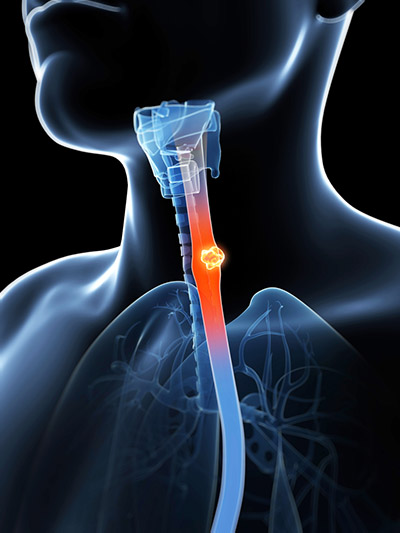
The incidence of oesophageal cancer has been steadily rising over the last 10 years. It usually affects the 50-75 age group and is more common in males than females. In the UK, the majority of oesophageal cancers are adenocarcinomas, which arise around the junction between the oesophagus and stomach. The other main type is squamous cell carcinoma, which usually occurs higher up in the oesophagus.
Who does it effect?
How is it detected?
The majority of patients will present with difficulty in swallowing. Any patients with swallowing difficulties or new reflux symptoms should be urgently investigated.
Some cancers are detected whilst patients are under surveillance for a condition known as Barrett’s Oesophagus. This is a change in the lining of the oesophagus due to the high exposure of the lower oesophagus to acid reflux. Patients with this condition are more likely to develop oesophageal cancer and are usually regularly checked by endoscopy.
How is the diagnosis made?
- CT Scan – A CT scan is a quick painless procedure to obtain detailed pictures of the body. Contrast will be given by injection during the procedure to highlight the blood vessels. It usually takes about 15mins.
- PET scan – This is a similar procedure to the CT scan and can sometimes be combined. Glucose is labelled and then administered via injection. Areas of high activity in the body take up the sugar and are then detected by the scanner. It is trying to detect any focus of cancer not picked up on the CT scan.
- EUS – This is a similar procedure to the endoscopy, except the probe has an ultrasound device on the end, which enables the doctor to examine the cancer and surrounding tissue in precise detail. It takes longer than an endoscopy and may require more sedation.
- Staging Laparoscopy – If the cancer is near the stomach, then a keyhole inspection of the abdomen is performed. Occasionally scans do not detect small areas of cancer, which are easily seen when viewed with a keyhole camera. The procedure is quick and patients go home a few hours after the procedure.