
Linx procedure

What is the Linx procedure ?

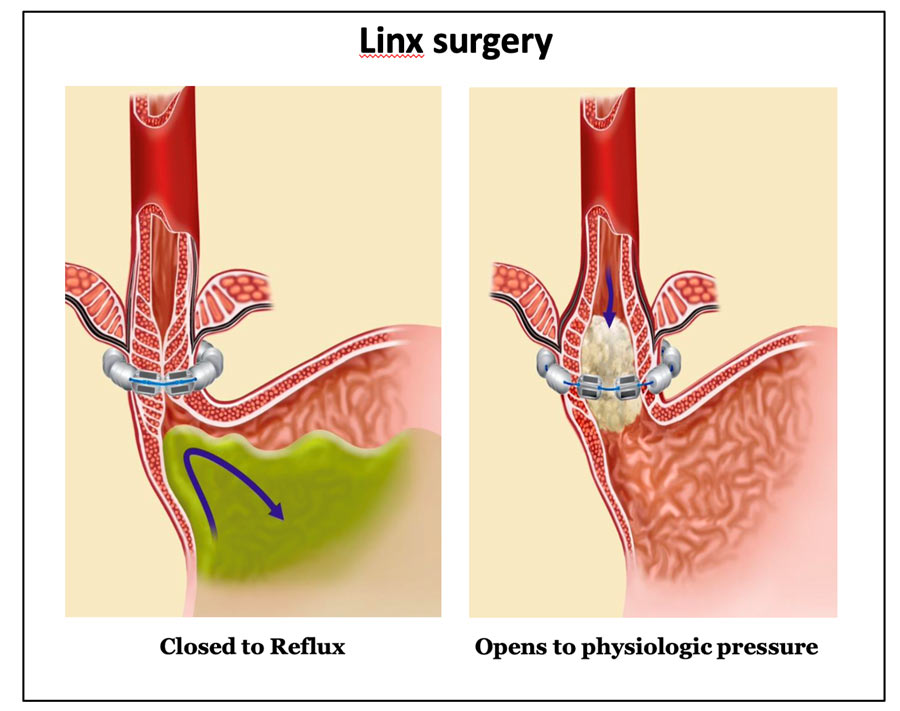
The LINX is a device placed around the junction of the stomach and the oesophagus (gullet) to control acid reflux symptoms. LINX is made of magnetic beads joined up to form a chain, like a bracelet. This is placed laparoscopically (keyhole surgery) under general anaesthesia. Approximately 5 small incisions are made in the upper abdomen to carry out the procedure, which will take about an hour. Following surgery, you will be taken to the recovery area where you will be monitored for a period of time before being transferred to the ward.

How it works

The magnetic beads separate (relax) when you swallow (allowing food to pass into the stomach) and close when you are not eating or drinking. The device in the closed position helps to prevent stomach contents refluxing back into the oesophagus.

Am I suitable for the Linx procedure?

The LINX procedure is suitable for patients with long standing gastro-oesophageal reflux symptoms who are not responding to medical therapy and life-style changes. Your surgeon will assess your symptoms and carry out a few tests to ensure your suitability to undergo the procedure. It is important to note that not everyone with acid reflux symptoms is suitable for surgery. A number of criteria have to be met in order to be suitable for a LINX device. Your surgeon will discuss these with you.

What tests do I need to assess my suitability?

Your surgeon will discuss these with you at the initial consultation. The number of tests may depend on your symptoms. You may require the following tests:

  1. Gastroscopy
  2. Barium swallow
  3. pH monitoring test
  4. BRAVO test

Do I need pre-operative tests?

You will be asked to attend a pre-operative assessment clinic approximately two weeks before surgery. You will be assessed for fitness for general anaesthesia. Your blood pressure, heart rate and oxygen saturation levels will be recorded and the nurses will go through a standard questionnaire. We will be taking blood and urine samples and also skin swabs to ensure you do not have any evidence of an MRSA infection.

What are the alternative treatment options?

1. Life style changes:

a. Eat little and often, avoid heavy meals in the night within 3 hours of sleep
b. Lose weight (if you are overweight)
c. Stop smoking and reduce alcohol consumption
d. Avoid foods which aggravate symptoms (fatty / fried food, caffeine)
e. Limit stress (a well-known trigger for acid reflux)

2. Medical therapy

a. Your GP, specialist or pharmacy might recommend acid medication which should help to control symptoms (e.g. Omeprazole, Lansoprazole, Famotidine)

3. Other forms of surgery

a. Anti-reflux surgery (fundoplication)

What are the side-effects and potential complications?

Difficulty swallowing: You will likely experience this to some degree in the short term. Usually, the swallowing improves over time but can peak at 6-12 weeks post-operatively. Rarely, you may continue to experience symptoms which require an endoscopic balloon dilatation (stretch) procedure. Very rarely, removal of the LINX device is required (<2%). Some patients can develop gas-related symptoms e.g. bloating or flatulence. These are usually temporary and can occur after any form of anti-reflux surgery. There is some preliminary evidence that swallowing and bloating issues may occur less often than following a fundoplication.

  1. The LINX device should not affect going through airport security systems.
  2. You are able to have an MRI scan provided it is less than 1.5 Tesla. You will be given a Linx card which should be presented to the radiology team in advance if an MRI is required.
  3. Very few patients (<0.5%) develop an erosion of the LINX device which requires surgical removal.

Shared decision-making

We would like you to be involved in the decision-making process. Your surgeon will explain the various options for treatment and you will be provided with written information. Following investigations and assessment of suitability, we will take you through the consent process. Please make sure you understand the procedure, side-effects and potential complications before you consent to the procedure.

How much pain will I experience?

Usually, the pain experienced following surgery is controlled with simple pain-killers. It is common to feel shoulder discomfort after any keyhole surgery. This is due to irritation of the diaphragm muscle from the gas used to inflate the abdomen. It usually improves within 24 hours. You will be discharged home with analgesics and anti-sickness tablets. Most people take pain-killers in some form for 5-7 days.

Post-operative diet

You will be able to start drinking fluids very soon after the procedure. We would like you to start eating soft food on the same day as the surgery. It is important to eat small and frequent (every 2-4 hours) meals. We recommend you commence a reasonably normal diet as soon as possible, although some things (dry bread, chicken and larger chunks of meat) invariably come towards the end of this process. You may have some trouble with your swallowing as you progress, which indicates that you need to chew your food longer. It is not unusual for swallowing issues to become more noticeable in the second week due to the swelling around the operation site. Persevering with a “little and often” diet is important if this happens. Swallowing issues can sometimes peak at 6-12 weeks following surgery, but usually settle down after this.

Recovery following surgery

You will be discharged on the day of surgery, with appropriate medications, unless any clinical reasons prevent you from doing so. You will be able to walk around and carry out most activities soon after surgery.

You can undertake any non-strenuous activity within two days of surgery. Avoid driving until you are able to perform an emergency stop without undue pain. Usually, a good sign of this is coming off the stronger pain-killers, often 7-10 days following surgery. Avoid heavy lifting or strenuous activities for 6 weeks.

You may experience constipation after surgery, often related to the pain killers. Simple laxatives such as lactulose or senna usually help to relieve symptoms.

When can I return to work?

Generally, it is recommended to take two weeks off after surgery. Your ability to return to work will depend on your job, your dietary intake and varies between individuals. Patients can often return to work a week after surgery if required, particularly remote working. We would not recommend flying immediately after surgery. This should be discussed on a case-by-case basis with the consultant.

When can I drive?

Driving should be avoided in the first week after surgery. Once you can perform an emergency stop in a stationary vehicle and turn to view your blind spot then driving should be safe. It is preferable to contact your insurance company to check for any specific instructions they may have.

Who do I contact if there are concerns?

The group practice telephone is answered in working hours and messages can be left out of hours. Any concerns will be relayed directly to the consultant surgeon on receipt. The hospital ward also provides a 24/7 means of contact. They will contact the consultant about any concerns and are able to give advice if required.

For more information on anti-reflux surgery in London, Hampshire or Surrey please contact us on davies@londonsurgicalgroup.co.uk

Follow-up

First follow up will be approximately 4 weeks after surgery. If you have any concerns prior to this, please contact the Consultant’s office in daytime hours or the hospital ward after hours.

You will receive six monthly follow up appointments for at least a year after surgery to guide you through your recovery.

See patient advice leaflet after surgery for Linx procedure